
Scissor lifting clamps are a cost-effective solution and ideal when a power source isn’t available. They can be effective for simple lifting tasks but come with several limitations:
- Grip Reliability and Confirmation
- Scissor clamps rely on mechanical force, often gravity, to secure a part. This force can vary depending on part weight and position, making it difficult to confirm if the grip is secure.
- Inconsistent gripping may lead to accidental drops, increasing the risk of damage to parts and injury to operators.
- Safety Concerns: Pinch Points
- The scissor mechanism naturally creates pinch points at its joints, posing a hazard to operators during operation or maintenance.
- These risks require additional guarding or operator training to mitigate.
- Space Constraints
- Scissor clamps need clearance for the expanding and contracting motion of the scissor mechanism, which can limit their use in tight workspaces or assembly lines with restricted room for movement.
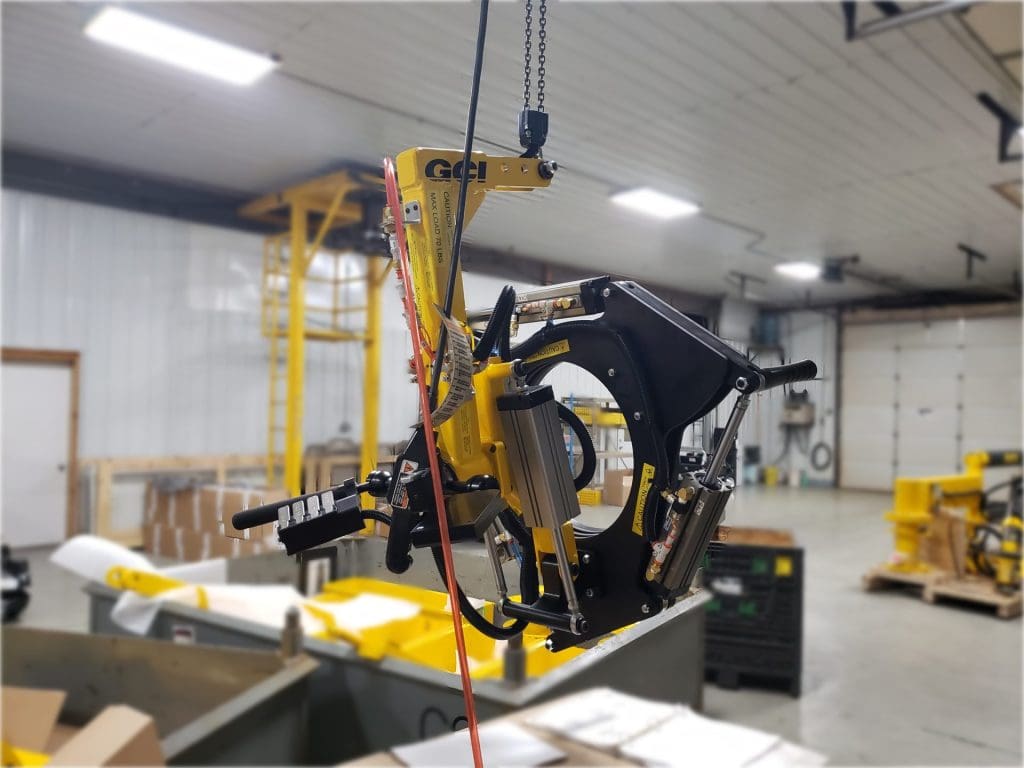
Pneumatic hook-mounted lift assist solutions, though requiring more upfront investment and access to a compressed air source, address these limitations and provide significant advantages:
- Reliable Gripping Mechanism
- Pneumatic grippers apply consistent, controlled force, ensuring a firm and reliable grip on the part.
- Some systems include sensors or feedback mechanisms to verify the grip in real time, reducing the risk of part drops.
- Enhanced Safety
- Pneumatic systems eliminate pinch points inherent to scissor mechanisms, reducing operator injury risks.
- Advanced safety features, such as load-holding valves, ensure the part remains secure even in the event of air pressure loss.
- Compact Design
- Pneumatic systems typically require less space, making them suitable for confined areas or highly automated environments where workspace optimization is critical.
- Improved Ergonomics and Precision
- Pneumatic lift assists can integrate with operator controls for smoother, more precise movements, reducing strain on the operator and improving task efficiency.
Conclusion
Use a pneumatic lift when reliability, safety, space-saving, and operator ergonomics are priorities—especially in high-throughput or safety-critical environments. While scissor clamps are viable for simpler, low-cost applications, pneumatic solutions are the better choice for industries requiring consistent performance and reduced operational risk.